
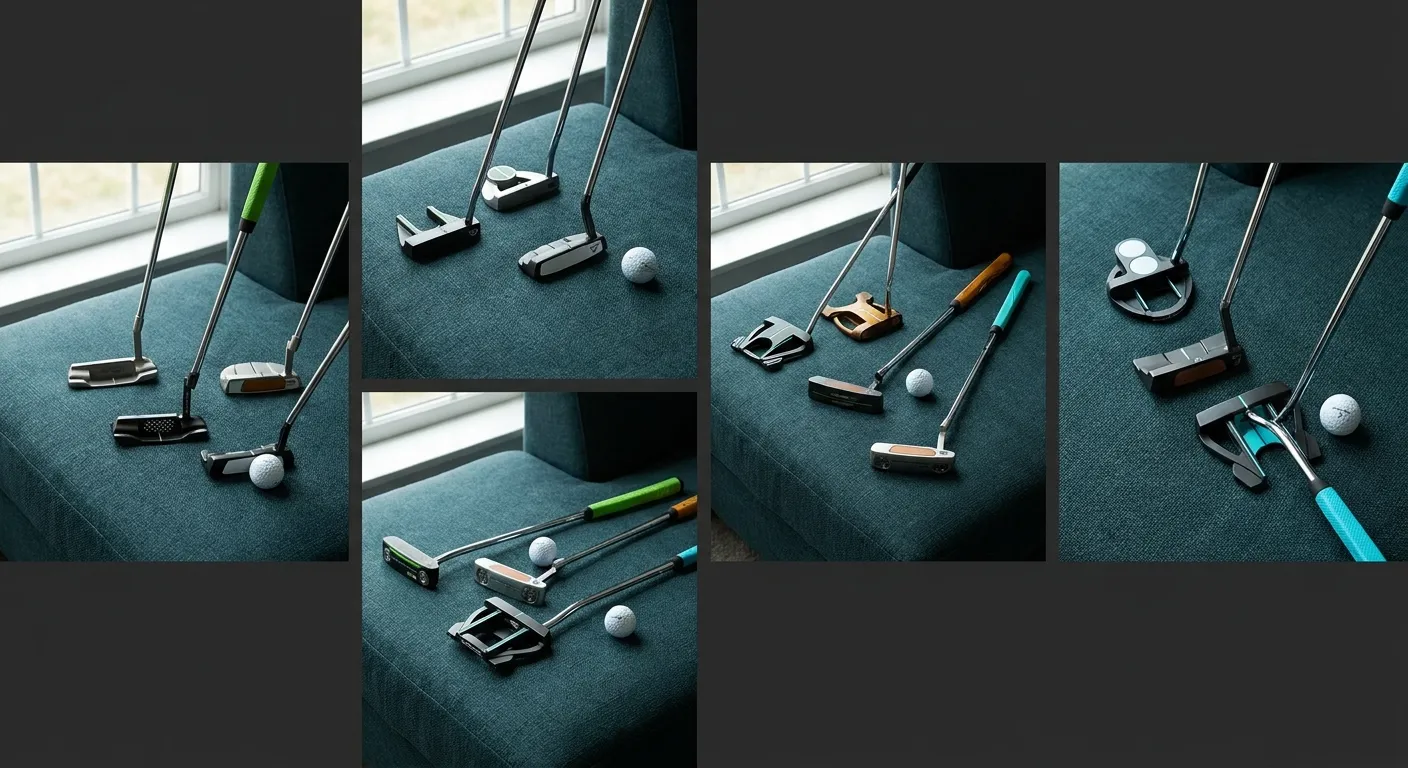
The putter is arguably the most used club in your bag, yet it’s often the most overlooked when it comes to careful selection. With countless styles, weights, and designs available, choosing the best golf putter for your stroke can feel daunting. At Golf Place, we believe that a well-matched putter can shave strokes off your game, making the search for your perfect match a worthwhile endeavor. This guide will compare popular putter types to help you make an informed decision.
Choosing the Best Golf Putter: Blade vs. Mallet
Putters generally fall into two main categories: blade and mallet. Blade putters are traditional, slender designs, often preferred by golfers with an arcing putting stroke. They offer excellent feel and feedback, allowing skilled players to control distance and line with precision. Their smaller head size can be less forgiving on off-center strikes, demanding a consistent stroke. Examples include classic Anser-style putters. Mallet putters, on the other hand, feature larger heads, often with intricate shapes and alignment aids. These designs distribute weight to the perimeter, increasing the moment of inertia (MOI) for greater stability and forgiveness on mishits. Mallets are typically favored by golfers with a straighter-back-and-through stroke or those seeking enhanced alignment assistance. They can reduce twisting on off-center hits, leading to more consistent roll. Examples range from half-moon shapes to futuristic designs.
Understanding Neck Styles and Weighting
Beyond head shape, the putter’s neck style significantly impacts its ‘toe hang’ – how much the toe points downwards when balanced on your finger. This relates to your stroke path: more toe hang suits an arcing stroke, while a face-balanced putter (minimal toe hang) is better for a straight stroke. Common neck styles include plumbers neck (moderate toe hang), flow neck (more toe hang), and double bend (face balanced). Weighting is another critical factor. Heavier putters can promote a smoother, more stable stroke, especially on fast greens, while lighter putters offer more feel. Many modern putters feature adjustable weights, allowing you to fine-tune the feel and balance. Ultimately, the best golf putter is the one that feels most comfortable in your hands, inspires confidence, and complements your natural putting stroke. Don’t be afraid to try different types on the practice green to find your ideal partner for the greens.
The Importance of Your Putting Stroke
Your putting stroke is perhaps the most crucial element in determining which putter type will suit you best. Golfers typically have one of three primary stroke types: straight-back-and-through, slight arc, or strong arc. Understanding your natural motion is the first step toward making an informed decision. For instance, a golfer with a strong arcing stroke will likely benefit from a putter with significant toe hang. This design allows the putter face to open and close more naturally with the arc of the stroke. Conversely, a golfer with a straight-back-and-through stroke usually finds more success with a face-balanced putter, which resists rotation and helps keep the face square to the target line throughout the stroke. Therefore, observing your stroke’s path is essential. You can do this by using alignment aids, mirrors, or even simple drills on the practice green. Many golf professionals also offer fitting sessions that can accurately identify your stroke type and recommend suitable putter characteristics. A proper fitting can truly elevate your short game, helping you sink more putts.
Exploring Different Putter Head Designs
While blade and mallet are the two overarching categories, within each, there’s a vast array of designs. Blade putters, for example, can vary in their overall length, the thickness of their top line, and the amount of offset. Some blades feature perimeter weighting to offer a touch more forgiveness than traditional models, bridging the gap between a pure blade and a compact mallet. Mallet putters showcase even more diversity. You’ll find half-moon mallets, square mallets, high-MOI mallets with wings, and even futuristic designs with multiple alignment lines and cut-outs. Each design aims to improve stability, aid in alignment, or enhance the feel. For example, some mallets incorporate high-contrast alignment aids that are particularly helpful for golfers who struggle with lining up putts. Others focus on distributing weight to the extreme edges to maximize MOI, thus minimizing the impact of off-center strikes. Consequently, experimenting with various head designs is highly recommended to see which visual cues and stability features resonate with your eyes and stroke. Consider how different shapes sit behind the ball and whether they instill confidence in your aiming. This personal preference is vital for choosing the best golf putter.
Grips and Their Impact on Putter Performance
Beyond the putter head and shaft, the grip plays a significant role in how the club feels and performs. Putter grips come in various shapes, sizes, and textures. Standard putter grips are typically round or slightly pistol-shaped. However, many golfers opt for oversized or jumbo grips. These larger grips can help reduce wrist action during the stroke, promoting a more stable and pendulum-like motion. Moreover, they can dampen the feel of the putter, which some golfers prefer for consistency, while others find it reduces feedback. There are also counter-balanced grips, which have weight added to the top end to shift the balance point closer to the hands. This can enhance stability and control, especially for golfers who struggle with a jerky stroke. Furthermore, the material of the grip also matters; some are tackier for better hold, while others prioritize softness for comfort. When selecting your grip, consider how it feels in your hands and whether it encourages the type of stroke you desire. A comfortable grip that provides good feedback, similar to how cushioned golf grips for better comfort and feel can improve your full swing clubs, is essential for consistent putting. Ultimately, the right grip can significantly influence your putting consistency and confidence.
Material and Insert Technology
Modern putters utilize a variety of materials and insert technologies, each designed to provide a distinct feel and sound. The putter face, in particular, can be made from milled steel, aluminum, copper, or feature various inserts. Milled putter faces, often found in high-end models, offer a very pure, crisp feel and sound, providing excellent feedback. Metal inserts, such as those made from copper or aluminum, can offer a slightly softer feel than a pure milled face. Polymer or elastomer inserts, on the other hand, provide the softest feel, often preferred by golfers who play on faster greens or those who desire a softer impact sensation. These inserts are designed to absorb vibration and create a consistent roll, even on off-center hits. For example, some putters incorporate grooves on the face to promote forward roll and reduce skidding. In fact, the choice of material and insert greatly affects the sound at impact, which is a critical component of feel for many golfers. Therefore, when testing different putters, pay close attention to how the ball comes off the face and the sound it produces. The ideal combination will provide a consistent roll and a satisfying feel, helping you become a better putter.
Alignment Aids: A Visual Advantage
Alignment is a critical component of putting success. Many putters, especially mallets, feature intricate alignment aids designed to help golfers aim more accurately. These can include single lines, multiple parallel lines, dots, or even geometric shapes. The effectiveness of an alignment aid is highly personal; what works for one golfer might be distracting for another. Some golfers prefer a very clean, minimalist look, relying solely on the top line of the putter. Others find that bold, contrasting lines help them visualize their target line more clearly. For instance, putters with a long alignment line running from the front to the back of the head can be particularly useful for ensuring the putter face is square to the target. Furthermore, some designs incorporate two parallel lines that frame the golf ball, assisting in setting up consistently. Ultimately, the best alignment aid is the one that allows you to confidently aim your putts without overthinking. Take the time to experiment with different visual cues on the practice green. A putter that helps you align correctly will undoubtedly improve your putting accuracy and reduce three-putts, much like golf tracking devices that boost performance in other areas of your game.
Adjustability and Customization Options
Modern putter technology has embraced adjustability, offering golfers the ability to fine-tune their putter to an unprecedented degree. Many models now come with adjustable weighting systems, typically using interchangeable sole weights. This allows golfers to alter the overall weight and the balance point of the putter, matching it to their stroke tempo and green conditions. For example, heavier weights might be preferred on faster greens to promote a smoother stroke, while lighter weights could offer more feel on slower surfaces. Additionally, some putters feature adjustable hosels, enabling changes to the lie angle. The lie angle is crucial for ensuring the putter sits flat on the ground at address, preventing the toe or heel from lifting. An incorrect lie angle can cause the putter face to open or close at impact, leading to missed putts. While less common, some putters even offer adjustable loft, though this is usually a setting for highly specific needs. These customization options highlight the importance of fitting, similar to the benefits of club customization for better golf performance across your entire set. Therefore, exploring these adjustable features can help you dial in the best golf putter for your individual preferences and playing style.
Practicing with Your New Putter
Acquiring a new putter is only half the battle; consistent practice is key to maximizing its potential. Once you’ve chosen the best golf putter, spend ample time on the practice green getting accustomed to its feel, weight, and alignment aids. Start with short putts to build confidence in your stroke and the putter’s roll. Gradually increase the distance, paying attention to your distance control. For instance, focusing on distance control practice for more consistent golf is paramount for putting. Drills that involve putting to a target without a hole can help you develop a better feel for pace. Furthermore, practice different types of putts – uphill, downhill, and breaking putts – to understand how your putter performs in various situations. It’s also beneficial to simulate on-course pressure by playing practice rounds where you keep score for putting only. Regular practice sessions will not only improve your putting stroke but also solidify your trust in your chosen putter. Remember, even the most technologically advanced putter requires a consistent stroke and good touch to perform optimally. Therefore, make practice a priority to truly unlock your putting potential.
The Role of Confidence in Putting
Beyond the technical aspects, confidence is an invaluable asset on the greens. When you stand over a putt, feeling confident in your club and your stroke can significantly influence the outcome. A putter that looks good to your eye and feels right in your hands naturally instills this confidence. This psychological edge can be just as important as any technical feature. For example, if you’re constantly second-guessing your alignment or the feel of your putter, it can lead to hesitation and poor strokes. Conversely, a putter that you trust allows you to focus purely on the read and the stroke, freeing you from unnecessary doubt. This is why the subjective ‘feel’ is so frequently emphasized in putter selection. It’s not just about the physical sensation but also the mental assurance it provides. Consequently, when testing putters, pay attention to how each one makes you feel. Does it inspire a sense of calm and precision? Does it make you want to step up and drain every putt? The best golf putter is ultimately the one that empowers you with the belief that you can make the putt. This mental component is often underestimated but vital for success on the greens.
Conclusion: Finding Your Perfect Putter Match
Selecting the best golf putter is a highly personal journey that blends technical understanding with individual feel and preference. We’ve explored the fundamental differences between blade and mallet putters, delved into the nuances of neck styles, weighting, and grip options, and examined the impact of material and alignment aids. We also considered the critical role of your putting stroke and the psychological boost that confidence provides. Remember, there’s no single ‘best’ putter for everyone; the ideal choice is unique to your stroke, your eye, and your feel. Take the time to visit your local golf shop or practice facility to try out various models. Roll putts with different head shapes, neck configurations, and grip sizes. Pay attention to how each putter sits behind the ball, how it feels at impact, and how consistently it rolls the ball. A professional putter fitting can also provide invaluable insights, helping you narrow down the options and make a truly informed decision. With the right approach and a bit of patience, you will undoubtedly find a putter that becomes a trusted extension of your hands, helping you to shave strokes off your score and enjoy your time on the greens even more. Your perfect short game partner awaits at Golf Place.
FAQ
What are the main types of golf putters?
The two main types are blade putters and mallet putters. Blade putters are traditional and slender, ideal for arcing strokes, while mallet putters have larger heads for stability and are often preferred for straighter strokes.
How does toe hang affect my putting stroke?
Toe hang refers to how much the putter’s toe points down when balanced. More toe hang suits an arcing stroke, allowing the face to open and close naturally. A face-balanced putter (minimal toe hang) is better for a straight-back-and-through stroke, resisting face rotation.
Should I consider an oversized putter grip?
Oversized grips can help reduce excessive wrist movement in your stroke, promoting a more stable and pendulum-like motion. They can also dampen the feel, which some golfers prefer for consistency. It’s a matter of personal preference and stroke mechanics.
What role do putter face inserts play?
Putter face inserts, made from various materials like polymer, elastomer, or different metals, affect the feel and sound at impact. They can provide a softer feel, absorb vibrations, and promote a consistent forward roll, impacting how the ball comes off the face.
How important is alignment when choosing a putter?
Alignment is extremely important. Many putters feature visual aids like lines or dots to help you aim accurately. The most effective alignment aid is one that helps you confidently and consistently line up your putts, reducing aiming errors and improving accuracy.