
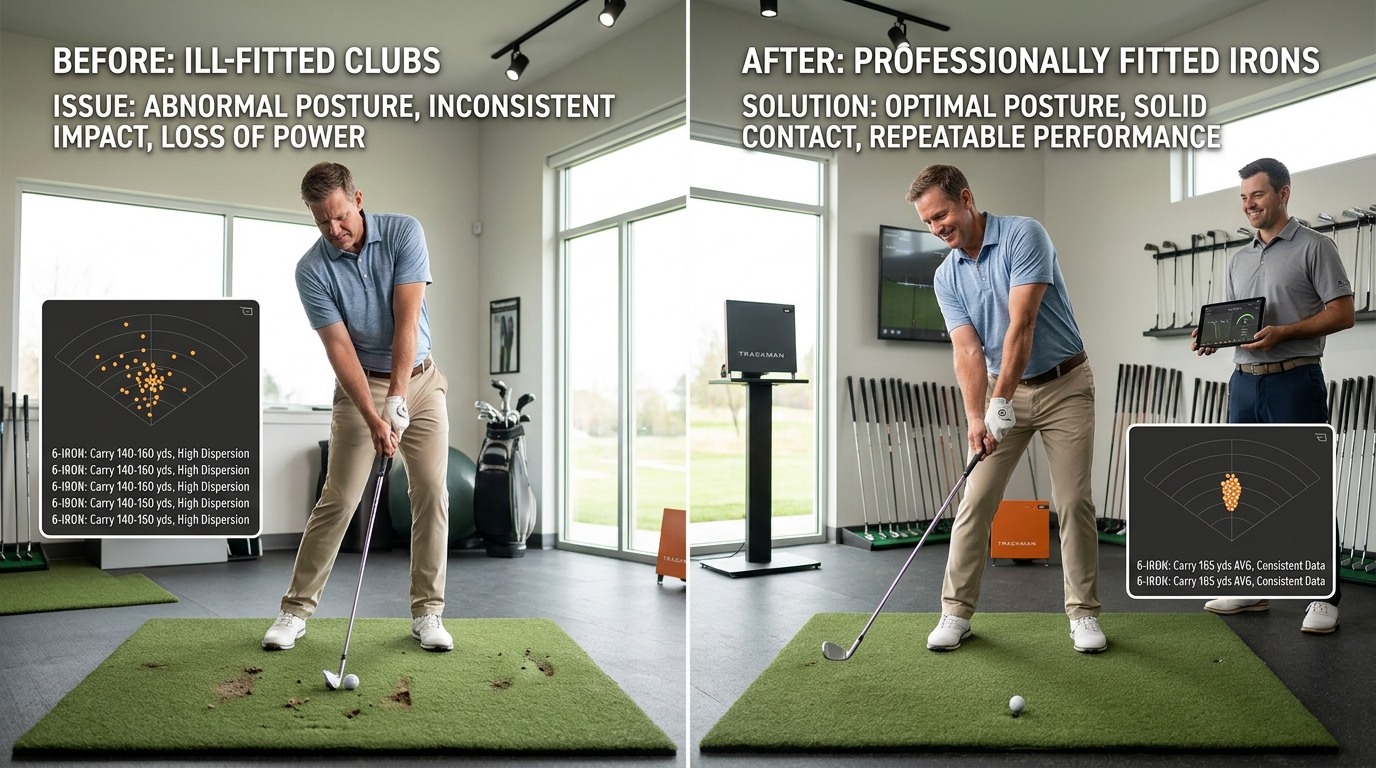
When golfers struggle with consistency, they often blame their swing, tempo, or even their mindset. However, one overlooked factor continues to sabotage performance on the course: poorly fitted irons. From subtle misalignments to major mismatches in shaft and lie angle, poorly fitted irons can quietly disrupt even the most solid swing mechanics. As a result, many players spend years trying to fix something that is not entirely their fault.
At first glance, a golf iron may seem like a standard tool. Yet, every player has a unique swing path, posture, and tempo. Because of this, using poorly fitted irons can lead to inconsistent ball striking, even if your fundamentals are sound. Therefore, understanding how club fit impacts your game becomes essential if you want predictable results.
Why Equipment Fit Matters More Than You Think
Most golfers assume that skill alone determines ball striking. While technique plays a major role, equipment fit directly influences how the club interacts with the ball. In fact, poorly fitted irons can cause subtle inconsistencies that compound over time, leading to frustration and lost confidence.
For example, if your irons are too long, you may struggle with control and balance. On the other hand, if they are too short, you might compensate by bending over excessively. Consequently, both situations create inconsistency in your strike location. Over time, this leads to unpredictable ball flights and distance gaps.
Additionally, shaft flex plays a critical role. If your shaft is too stiff, you may struggle to square the clubface at impact. Conversely, a shaft that is too flexible can cause timing issues. As a result, poorly fitted irons create a disconnect between your swing and the club, making consistency difficult to achieve.
How Lie Angle Affects Ball Striking
Lie angle is one of the most overlooked aspects of club fitting. It refers to the angle between the shaft and the ground when the club is at address. Even a small mismatch in lie angle can cause significant issues.
When poorly fitted irons have the wrong lie angle, the clubface will not sit square at impact. If the toe is too high, the ball tends to go left. If the heel is elevated, the ball often leaks to the right. Therefore, your ball flight becomes inconsistent, even if your swing path is correct.
Moreover, improper lie angles can lead to uneven turf interaction. You may notice that your divots are deeper on one side. This uneven contact further affects ball striking consistency. Over time, these small deviations add up, making it harder to trust your swing.
The Role Of Shaft Length And Control
Shaft length directly impacts your posture and swing arc. When using poorly fitted irons, the wrong shaft length can throw off your entire setup. As a result, you may unconsciously adjust your stance to compensate.
For instance, longer shafts can make the club feel heavier and harder to control. This often leads to off-center strikes. Meanwhile, shorter shafts may force you into an uncomfortable posture, reducing power and consistency. Because of this, poorly fitted irons disrupt your natural swing rhythm.
In addition, incorrect shaft length can affect your timing. A mismatch forces you to adjust mid-swing, which leads to inconsistent contact. Therefore, achieving repeatable ball striking becomes nearly impossible without the right fit.
Shaft Flex And Tempo Mismatch
Another critical factor is shaft flex. Every golfer has a unique tempo, and the shaft must match that tempo for optimal performance. When using poorly fitted irons, a mismatch in flex can lead to erratic ball striking.
If the shaft is too stiff, it may not load properly during the swing. As a result, you lose power and struggle with timing. On the other hand, if the shaft is too flexible, it can overbend, causing inconsistent face angles at impact. Consequently, poorly fitted irons create unpredictable shot patterns.
Furthermore, flex mismatches can affect confidence. When your shots vary without clear reason, frustration builds. Over time, this impacts your mental game, making it even harder to perform consistently.
Clubhead Design And Forgiveness
Not all irons are created equal. Clubhead design plays a major role in forgiveness and performance. When golfers use poorly fitted irons that do not suit their skill level, they often struggle with consistency.
For example, low-handicap players may prefer compact irons with less forgiveness. However, if a beginner uses these clubs, off-center hits become more punishing. As a result, inconsistent ball striking becomes the norm.
Similarly, game-improvement irons offer more forgiveness. Yet, if an advanced player uses them, they may lose control over shot shaping. Therefore, poorly fitted irons that do not match your skill level can limit your performance.
Grip Size And Hand Action
Grip size is another overlooked factor that affects ball striking. While it may seem minor, the wrong grip size can significantly impact your swing mechanics. Poorly fitted irons with incorrect grip size can alter how your hands release through impact.
If the grip is too small, your hands may become overly active. This often leads to hooks or inconsistent strikes. Conversely, if the grip is too large, it can restrict hand movement, causing weak shots. As a result, poorly fitted irons disrupt your natural swing feel.
Additionally, grip comfort plays a role in confidence. When your hands feel secure, you can focus on execution rather than compensation. Therefore, proper grip fitting is essential for consistent ball striking.
How Poor Fit Creates Compensations
One of the biggest dangers of poorly fitted irons is the development of compensations. When your equipment does not match your swing, your body instinctively adjusts to make contact with the ball.
Initially, these adjustments may seem helpful. However, they often lead to inconsistent results. For example, you might change your swing path to compensate for a lie angle issue. Over time, this creates bad habits that are difficult to break.
Moreover, compensations make it harder to identify the root cause of inconsistency. You may spend hours practicing, yet your results remain unpredictable. Therefore, poorly fitted irons not only affect performance but also slow your improvement.
Signs Your Irons Are Holding You Back
Many golfers are unaware that their equipment is causing issues. However, certain signs can indicate that you are using poorly fitted irons.
- Inconsistent ball flight despite a solid swing
- Uneven divots or strange turf interaction
- Difficulty controlling direction or distance
- Frequent off-center hits
- Lack of confidence with iron shots
If you notice these patterns, your clubs may be part of the problem. Therefore, addressing the fit can lead to immediate improvements.
The Benefits Of Properly Fitted Irons
Switching from poorly fitted irons to properly fitted ones can transform your game. When your clubs match your swing, everything feels more natural. As a result, consistency improves significantly.
You will notice more centered contact, better distance control, and tighter dispersion. Additionally, your confidence will increase, allowing you to commit to each shot. Over time, this leads to lower scores and a more enjoyable experience on the course.
Moreover, proper fitting eliminates the need for compensations. Instead of adjusting your swing, you can focus on refining your technique. Therefore, investing in the right equipment is a smart move for any golfer.
Getting Fitted The Right Way
A professional fitting session is the best way to avoid poorly fitted irons. During a fitting, experts analyze your swing, ball flight, and physical characteristics. This data helps determine the ideal specifications for your clubs.
The process typically includes testing different shaft lengths, flexes, and lie angles. Additionally, launch monitors provide valuable insights into your performance. As a result, you receive recommendations tailored to your game.
While fittings may seem expensive, they often save money in the long run. Instead of buying multiple sets, you invest in equipment that works from the start. Therefore, avoiding poorly fitted irons becomes easier with proper guidance.
Conclusion
Inconsistent ball striking can be frustrating, especially when you are putting in the effort to improve. However, the problem is not always your swing. Poorly fitted irons can quietly undermine your performance, making consistency difficult to achieve. From lie angle and shaft length to grip size and club design, every detail matters more than most golfers realize.
By addressing these factors, you can eliminate unnecessary variables and focus on what truly matters: executing your swing with confidence. Ultimately, the right equipment allows your skills to shine, leading to better results and greater enjoyment on the course. If you are serious about improving your game, it may be time to take a closer look at your irons and ensure they are working for you, not against you.
FAQ
1. How do I know if my irons are not suited to me?
Look for inconsistent ball flight, poor contact, and unusual divot patterns. These signs often point to a mismatch in club specifications.
2. Can club fitting really improve my consistency?
Yes, proper fitting aligns your equipment with your swing, which leads to more predictable contact and better overall performance.
3. How often should I get my irons checked?
It is wise to review your setup every couple of years or after significant changes in your swing or physical condition.
4. Do beginners need custom-fitted clubs?
While not mandatory, beginners benefit from proper fit because it helps build good habits from the start.
5. Is shaft flex more important than clubhead design?
Both matter, but shaft flex directly affects timing and control, making it a crucial factor in achieving consistent ball striking.