
Finding the right golf ball can transform your game, yet many players never take the time to test properly. Instead, they rely on brand names or recommendations that may not suit their swing. Because of this, learning how to match golf ball swing speed effectively is one of the smartest steps you can take to improve performance. When your ball complements your swing, every shot feels more consistent, controlled, and powerful.
Golf balls are engineered with different compression levels, spin rates, and constructions. These factors interact directly with your swing speed. As a result, using the wrong ball can limit your distance and accuracy, even if your technique is solid. Therefore, understanding golf ball swing speed relationships allows you to unlock your true potential without changing your swing.
Why Golf Ball Swing Speed Matching Matters
Swing speed determines how the ball compresses at impact. When compression aligns correctly, energy transfer becomes more efficient. Because of this, golf ball swing speed matching is essential for maximizing both distance and control.
If the ball is too firm for your speed, it will not compress properly. As a result, you lose distance and feel. On the other hand, if the ball is too soft, it may over-compress, leading to inconsistent flight and excess spin. Matching the right ball to your swing creates balance and improves overall performance.
For more insights on ball selection, you can also explore trusted sources like the USGA equipment guidelines: https://www.usga.org
Understanding Compression And Ball Performance
Compression is a key factor when evaluating golf ball swing speed. It refers to how much the ball deforms during impact. Lower compression balls are softer and easier to compress, while higher compression balls require faster swings.
Golfers with slower speeds benefit from low-compression balls. These balls help generate more distance by maximizing energy transfer. In contrast, players with faster swings often prefer higher compression for better control and reduced spin.
However, compression alone is not enough. It must be tested alongside spin and launch characteristics. Because of this, golf ball swing speed testing involves evaluating how all these elements work together.
How To Set Up A Proper Testing Process
A structured approach is important when testing golf ball swing speed. Random testing can lead to misleading results. Therefore, consistency is key when comparing different options.
Start by selecting a few golf balls with varying compression levels. Use the same club for each test to maintain consistency. In addition, hit multiple shots with each ball to identify patterns rather than relying on a single outcome.
Recording your data is also helpful. Track distance, ball flight, and feel for each shot. As a result, you can compare performance more accurately. If you want to improve your testing setup, check our guide on golf equipment basics at /golf-insights-and-tips.
Testing On The Range And On The Course
Where you test matters just as much as how you test. Many golfers begin on the driving range, which provides a controlled environment. Because of this, it is a good place to evaluate golf ball swing speed initially.
On the range, you can focus on distance, launch, and consistency. However, range conditions may not reflect real gameplay. Balls used at ranges are often different from premium golf balls.
Therefore, it is important to test on the course as well. Real conditions provide insights into performance under pressure. As a result, combining both environments gives you a complete picture.
Evaluating Distance And Ball Flight Patterns
Distance is often the first metric golfers consider. However, it should not be the only factor. When testing golf ball swing speed, pay attention to ball flight as well.
Observe how high the ball launches and how it travels through the air. A ball that flies too low may reduce carry distance. In contrast, excessive height can lead to loss of control in windy conditions.
Consistency is equally important. A ball that delivers similar distances across multiple shots is more reliable. Therefore, evaluating both distance and flight ensures better decisions.
Assessing Spin And Short Game Control
While distance matters, control is equally important. When analyzing golf ball swing speed, do not ignore short game performance. Spin plays a major role in how the ball behaves around the greens.
Higher spin allows the ball to stop quickly, improving precision. However, too much spin can reduce distance off the tee. Because of this, finding the right balance is essential for overall performance.
Test different balls with chips and pitches. Observe how they react on landing. As a result, you can choose a ball that provides both distance and control.
The Importance Of Feel And Feedback
Feel is a personal factor, yet it strongly influences confidence. When testing golf ball swing speed, pay attention to how the ball feels at impact. A comfortable feel can improve your overall experience.
Softer balls often provide better feedback, especially on short shots. In contrast, firmer balls may feel more solid and responsive. Because of this, your preference plays a role in your final decision.
Confidence comes from familiarity. When you like how a ball feels, you trust your swing more.
Using Technology To Improve Accuracy
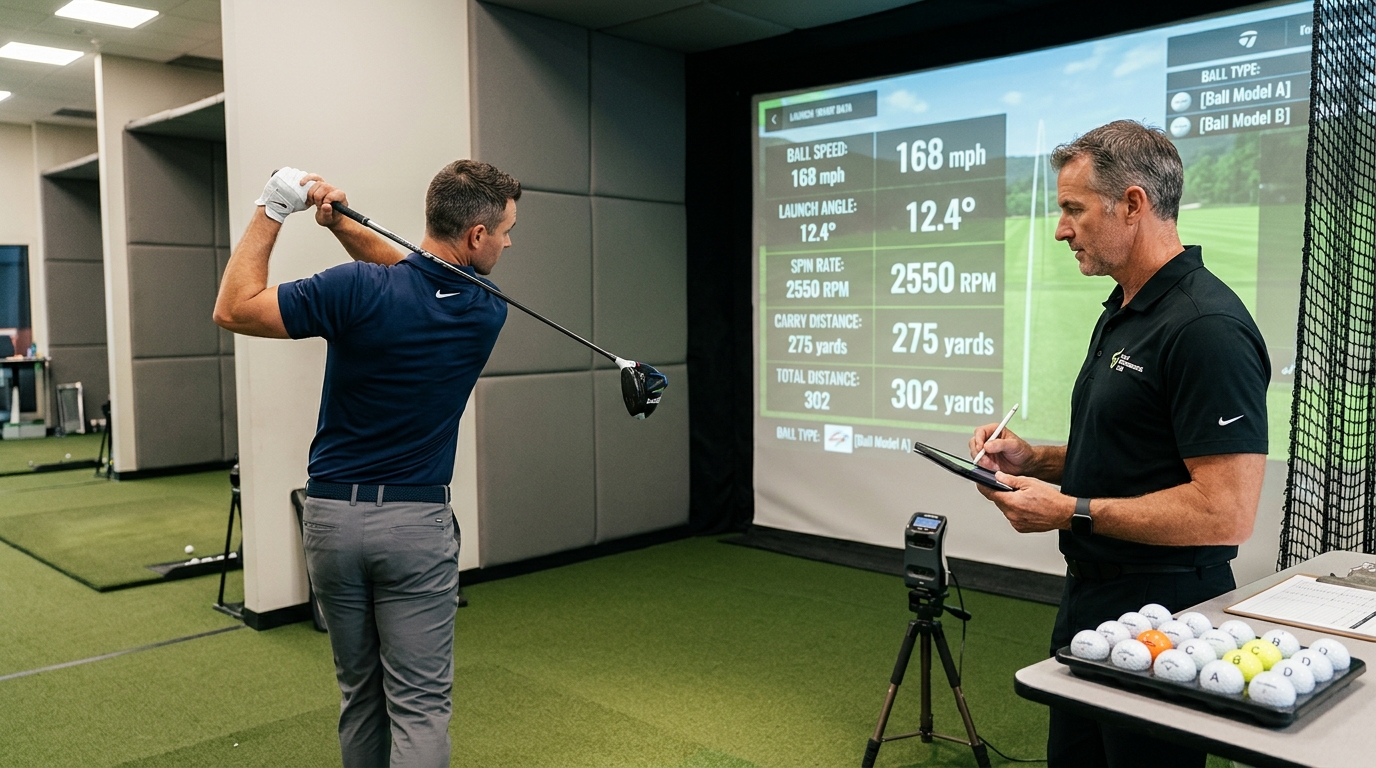
Modern technology can enhance your testing process. Launch monitors provide detailed data, including ball speed, spin rate, and launch angle. Because of this, they make it easier to evaluate golf ball swing speed accurately.
These tools eliminate guesswork. They allow you to compare different balls based on measurable performance. As a result, your decisions become more informed.
If you’re interested in deeper data tracking, you can also read our article on golf performance tracking at /golf-buying-guides.
Avoiding Common Testing Mistakes
Many golfers make mistakes when testing equipment. One common issue is switching balls too quickly. Because of this, they fail to gather enough data for accurate comparison.
Another mistake is focusing only on distance. While distance is important, control and consistency matter just as much. Ignoring these factors can lead to poor decisions.
In addition, testing under inconsistent conditions can skew results. Weather, fatigue, and swing changes all affect performance.
How Often You Should Retest Golf Balls
Your swing evolves over time. As a result, the ball that works today may not be ideal in the future. Because of this, it is important to periodically reassess golf ball swing speed compatibility.
Changes in technique, strength, or equipment can all influence performance. Retesting allows you to adapt to these changes and maintain consistency.
In addition, new ball designs are introduced regularly. These advancements may offer improved performance.
Making The Final Decision With Confidence
After testing, it is time to choose the best ball for your needs. Look for consistency across all areas, including distance, control, and feel. Because of this, your decision should be based on overall performance rather than a single metric.
Confidence is also important. Choose a ball that feels right and performs reliably. As a result, you will trust your equipment during play and make better decisions on the course.
Conclusion
Improving your golf game does not always require major swing changes. Sometimes, the key lies in choosing the right equipment. Understanding golf ball swing speed gives you the knowledge needed to make smarter decisions.
By evaluating compression, spin, distance, and feel, you can find a ball that matches your swing perfectly. As a result, your shots become more consistent and controlled.
Ultimately, the effort you put into testing pays off. With the right ball in play, you can focus on your game and enjoy every round with improved results.
FAQ
1. How many golf balls should I test before choosing one?
Testing three to five different options provides a reliable comparison.
2. Can beginners benefit from matching ball to swing speed?
Yes, even beginners can improve distance and consistency with the right ball.
3. Is compression the most important factor?
It matters, but it should be evaluated along with spin and feel.
4. Should I test balls with every club?
Testing with both driver and short game shots gives better insights.
5. How long should a testing session last?
A focused session of one to two hours is usually enough.