
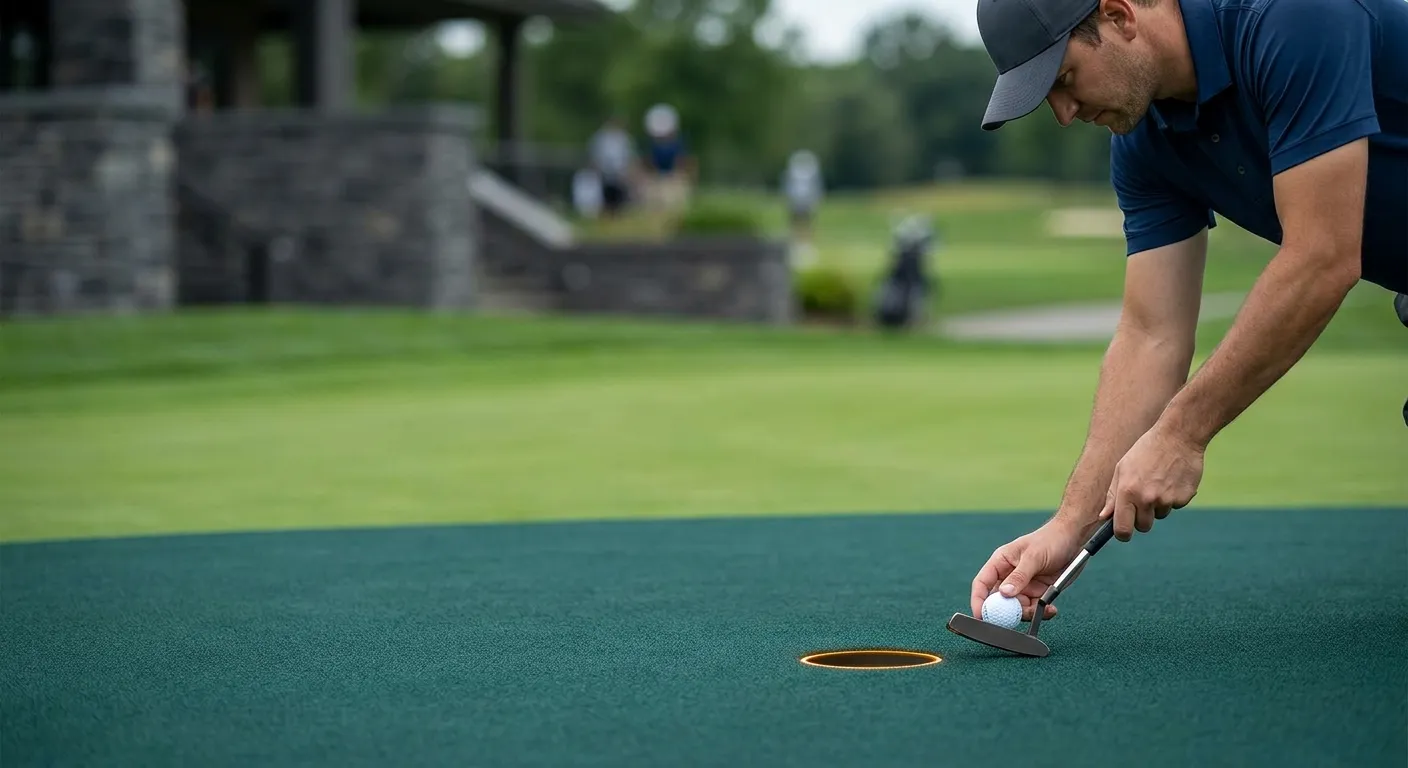
Putting is often said to be where golf games are won or lost, and nowhere is this more true than with short putts. The ability to consistently hole those crucial putts within ten feet can dramatically lower your scores and boost your confidence on the green. Many golfers struggle with consistency on these seemingly simple shots, but with the right approach and practice, you can significantly improve short putts and transform your putting performance. Furthermore, understanding the nuances of your setup and stroke is paramount for success.
Master Your Setup and Stroke to Improve Short Putts
To consistently improve short putts, begin with a solid setup. Ensure your eyes are directly over the ball, and your putter face is square to your target line. Your grip should be firm enough for control but relaxed enough to allow a smooth, pendulum-like stroke. For short putts, the stroke should be compact, with minimal wrist movement. Focus on keeping the putter head low to the ground through impact and maintaining a consistent tempo. A slight forward press with your hands can help engage the stroke and prevent deceleration. Consequently, this foundational work establishes a reliable base for every putt.
Moreover, consider your stance. A stable lower body is crucial for eliminating unnecessary movement during the stroke. Many top professionals advocate for a slightly wider stance on short putts to enhance stability. Your weight distribution also plays a role; try to feel balanced and centered over the ball, perhaps with a slight lean towards your lead foot. This can help promote a descending blow and a more solid impact. Furthermore, ensure your alignment is precise. Use a line on your golf ball to help you aim directly at the hole or your intended start line. This visual aid can significantly enhance your accuracy.
The Importance of Putter Selection for Short Putts
While technique is vital, the right equipment can also help you improve short putts. The putter itself plays a significant role in consistency. Different putter styles, such as blade, mallet, or mid-mallet, offer varying levels of forgiveness and feel. A putter that suits your stroke type can make a considerable difference. For example, golfers with a straight-back-straight-through stroke might prefer a face-balanced putter, while those with an arc might benefit from a toe-hang design. Visiting a reputable Golf Shop to get fitted for a putter can be a worthwhile investment. In fact, even the grip on your putter can impact performance. A thicker grip, for instance, can reduce wrist action, which is often beneficial for controlling short putts.
Furthermore, the material and insert of your putter face affect feel and roll. Softer inserts typically provide more feedback and a more muted sound, which some golfers prefer for delicate short putts. Conversely, firmer inserts can offer a more consistent roll on faster greens. Understanding these subtle differences and how they interact with your stroke and preferred feel is key. Don’t underestimate the impact of a putter that feels comfortable and inspires confidence in your hands. After all, confidence is a major component of successful putting.
Practice Drills for Short Putt Confidence and Consistency
Regular practice is essential to improve short putts. One effective drill is the ‘Gate Drill.’ Place two tees just wider than your putter head, creating a gate. Practice putting through this gate, ensuring a straight back and through stroke. This drill helps refine your stroke path and promotes a square putter face at impact. Another valuable drill is the ‘Clock Drill.’ Place balls in a circle around the hole at 2, 3, and 4 feet, then try to sink all of them consecutively. If you miss, start over. This drill builds pressure awareness and consistency. Remember, the goal is not just to make the putt, but to hit it with the same speed and line every time, even if it’s a short one. Consistent repetition of these drills will ingrain the muscle memory needed to make short putts feel automatic under pressure. Moreover, consider using Golf Training aids to enhance your practice sessions.
In addition to these, the ‘One-Handed Putting Drill’ can be incredibly beneficial. Practice putting with only your dominant hand, then with only your non-dominant hand. This drill helps to develop feel and control independently for each hand, which then translates to better coordination when putting with both hands. It forces you to focus on the clubface and path, highlighting any tendencies to manipulate the putter. Consequently, you will develop a more integrated and controlled stroke. Try practicing with your eyes closed after setting up to the ball; this can enhance your feel for the stroke and the target.
Reading Greens and Speed Control for Short Putts
While the mechanics of your stroke are vital, reading greens and controlling speed are equally important to improve short putts. Even a two-foot putt can have subtle breaks. Take your time to walk around the hole, observe the contours, and identify the highest point of the break. Look for grain direction, which can influence how much a putt breaks and its speed. For instance, putts against the grain will be slower and break less, whereas putts with the grain will be faster and break more. Learning to read these nuances comes with experience, but deliberate practice will accelerate your skill development.
Speed control is another critical element. On short putts, many golfers tend to either hit it too hard, sending it past the hole, or too soft, leaving it short. The ideal speed is one that allows the ball to just fall into the cup, rather than ramming it in. This ‘dying speed’ gives the ball the best chance to grab the edge of the hole and drop. Practice varying your stroke length and tempo to achieve different speeds. A good drill is to try to roll putts to a specific distance past the hole without actually putting into it. This helps you calibrate your stroke for precise distance control. Developing a consistent tempo is perhaps the most important aspect of speed control. Many pros use a consistent rhythm, such as ‘one-two’ for the backstroke and forward stroke. For further insights into green reading, consider resources like those found on the USGA website.
Mental Game Strategies to Improve Short Putts
Beyond technique and practice, the mental aspect of putting is paramount, especially on short putts. Pressure can cause even the most skilled golfers to falter. Developing a consistent pre-shot routine is one of the most effective ways to manage nerves. This routine should be the same for every putt, regardless of its length or importance. It might involve taking a deep breath, visualizing the ball going into the hole, and then taking your stance. By following a routine, you train your mind to focus on the task at hand rather than the outcome. Consequently, this helps to calm your nerves and promote a smooth stroke.
Visualization is a powerful tool. Before you even address the ball, close your eyes for a moment and picture the ball rolling along its intended line and dropping into the cup. Feel the sensation of making the putt. This positive imagery can program your subconscious for success. Furthermore, learn to accept misses. Even professional golfers miss short putts. The key is to not let one missed putt affect your next. Stay in the present moment and focus on the next shot. Maintaining a positive attitude, even after a poor putt, is crucial for sustained improvement. For more on the mental side of golf, publications like those from the Golf Distillery can offer valuable perspectives.
Course Management and Strategy for Short Putts
Effective course management can indirectly help you improve short putts by reducing the number of pressure putts you face. When approaching the green, consider where to miss to leave yourself with the easiest possible putt. Sometimes, playing to the fat part of the green, even if it leaves a longer putt, is a better strategy than aggressively going for a pin tucked behind a bunker, which might lead to a difficult chip and a testing short putt for par. Understanding your strengths and weaknesses around the green allows you to make smarter choices. For example, if you struggle with downhill putts, try to leave yourself uphill putts whenever possible.
Furthermore, pay attention to the overall conditions of the course. How fast are the greens rolling today? Is there wind affecting the ball’s path? Adjusting your approach based on these factors is vital. Sometimes, a slightly firmer stroke is required on slower greens, while a lighter touch is needed on lightning-fast surfaces. Being adaptable and making intelligent choices before you even get to the green can significantly reduce the pressure on your short putting game. This holistic approach to golf helps in creating more manageable situations on the green.
Advanced Techniques to Improve Short Putts
Once you have mastered the basics, you can explore more advanced techniques to further improve short putts. One such technique is the ‘AimPoint’ method, which involves using your feet to feel the slope of the green and estimate the break. While it requires practice to master, many golfers find it incredibly effective for reading subtle breaks. Another advanced concept is understanding the ‘effective hole size.’ The hole essentially becomes smaller the faster the ball is rolling. Therefore, focusing on dying speed on short putts maximizes the effective size of the hole, increasing your chances of sinking it. This nuanced understanding elevates your putting strategy.
Consider also the impact of different putter grips. While a standard grip is common, some golfers find success with alternative grips like the claw grip, cross-handed grip, or even a belly or broomstick putter (within rules). These grips can help stabilize the putter face, reduce wrist breakdown, and promote a more consistent stroke. Experimenting with these options in practice can reveal what works best for your individual stroke and help you to improve short putts even more. Remember, the goal is always consistency and confidence, so find what feels most natural and effective for you. You can find many of these alternative grips and other Golf Gear options in our shop.
Mastering your short putting requires dedication to proper technique and consistent practice. By focusing on a precise setup, a controlled stroke, and incorporating targeted drills into your routine, you will quickly see a tangible improvement in your ability to sink those critical short putts, leading to lower scores and more enjoyment on the course. Continue to refine your green reading, manage your mental game, and adapt your strategies to truly excel on the greens. Ultimately, consistent practice and a thoughtful approach are the keys to unlocking your full putting potential.
FAQ: Improving Your Putting Performance
What is the best way to practice short putts?
The best way to practice short putts involves a combination of drills focusing on alignment, stroke path, and speed control. The ‘Gate Drill’ for stroke path and the ‘Clock Drill’ for consistency at various short distances are highly effective. Additionally, practicing with one hand or with your eyes closed can significantly enhance your feel.
How can I stop three-putting from short distances?
To avoid three-putting from short distances, focus on two key areas: speed control and green reading. Learn to hit putts with a ‘dying speed’ that allows the ball to just fall into the cup. Spend time observing the green’s contours and grain to accurately predict breaks. A consistent pre-shot routine also helps manage pressure.
What role does my putter play in making short putts?
Your putter plays a crucial role in making short putts. The right putter, fitted to your stroke type, can provide better feel, forgiveness, and consistent roll. Different head designs (blade, mallet) and grip styles can influence your stroke mechanics and overall confidence. Consider a professional fitting to find your ideal putter.
Are there any mental strategies to improve short putt consistency?
Yes, mental strategies are vital for short putt consistency. Develop a consistent pre-shot routine to calm nerves and focus. Visualize the ball going into the hole before you strike it. Learn to accept misses and maintain a positive attitude, focusing only on the current putt rather than past outcomes.
How important is alignment for sinking putts from close range?
Alignment is critically important for sinking putts from close range. Even a slight misalignment can cause the ball to miss the hole. Ensure your eyes are directly over the ball and your putter face is square to your target line. Using a line on your golf ball can be a simple yet effective way to verify your alignment before each putt.