
Choosing golf clubs for beginners is a shopping note, not a test. This page does not rank brands and it does not report a market size. It tells you what to write down before you pay. The number of clubs you may carry in a round is a rules question. Read it on Rule 4. Whether a club is conforming is a separate question. Read that on the USGA equipment standards page. Do not take either answer from this article.
Choosing golf clubs for beginners starts with the job of each club
A first set is a set of jobs, not a wall of new heads. Write one row for each job you actually need on the holes you will play. A tee shot. A longer shot from the fairway. A middle shot to the green. A short shot around the green. A putt. If a row has no job, you do not need that club yet. Leave it off the note.
On each row, write the club name the seller is offering, then leave three blanks: loft, shaft, and grip. You will fill those blanks from the maker’s page or from the tag on the club, not from memory and not from this article. If the page and the tag disagree, stop. Ask which one the shop will sell you. Write the answer in their words.
Do not write a distance you hope the club will produce. This page has no distance chart. If a fitter or a seller offers a number, ask where it came from and write that source on the row. A number with no source does not belong on the note.
What to copy, and what to leave blank
Open the maker’s page for the exact head in front of you. Copy the model name as it is printed. Copy the loft as it is printed. Copy the shaft name as it is printed. If the page does not show a field, leave the cell blank. A blank is honest. A guessed loft is not.
Ask whether the club in the rack is the same build as the page. A demo head can wear a different shaft than the one in the box. Write ‘demo’ or ‘boxed’ on the row. If you are looking at a used club, write what you can see: face wear, a loose head, a grip that is shiny or torn. Do not call a used club ‘like new’ because the price is low.
A starter package can be convenient because the clubs arrive together. It is still a list of rows. Open each club and match it to a row. If the package includes a club you have no job for, say so before you pay. You can ask the shop to explain the job in one sentence. If they cannot, that club is not a reason to buy the package.
Forgiveness is a design word, not a promise
Sellers use ‘forgiving’ to describe a head shape. This page will not tell you that a larger head or a cavity back will straighten your shots. Those are claims you should read on the maker’s page, and you should treat them as the maker’s description, not as a result this site measured. Write the words the page uses. Do not upgrade them.
The same rule applies to shaft flex. The label on the shaft is a label. It is not a measurement of your swing. If a shop suggests a flex, ask them to say why, and write the reason. Do not accept a flex because it is the one in the beginner package. Do not reject a flex because someone online called it a senior flex. The label and the reason are the note.
Length and grip size are the same kind of note. If the clubs are a standard build, write ‘standard, as sold.’ If someone suggests a change, write the change and who suggested it. This article will not tell you that your height requires a longer club. It will not tell you that a thick grip cures a slice. Both of those would be claims this page did not test.
A first set you can actually carry
Before you add another head, read Rule 4 again and count the clubs you intend to take onto the course. The count is a rules check, not a shopping target. You do not have to fill a bag to the limit. A shorter list is easier to learn. Write the clubs that will stay home.
Put the putter on its own row. You will use it on every hole you play. Look at how the head sits behind a ball on a flat part of the shop floor, if the shop will let you. Write whether you can see an aim line you understand. Do not write that a mallet is better than a blade. That ranking is not on this page. Write the shape you can aim, and the reason you can aim it, in your own words.
Wedges are easy to overbuy. A package pitching wedge can be the only short club you need at the start. A sand club is a separate row with a separate job: a bunker, if the courses you play have them. If you do not yet play bunkers, you can leave that row blank. You can add it later from a maker’s page, not from a slogan.
New, used, or borrowed
Three ways to get the clubs, and three different notes. New: the page, the box, and the receipt should name the same model. Used: the face, the grooves, the grip, and the hosel are the inspection. Borrowed or rented: write whose clubs they are and that you will return them. Do not treat a rented set as a review of the brand.
Ask the price of the set and the price of any change, such as a grip swap, on the day you are standing there. Write the figures they say. This article does not print a price. If a fitting fee is credited toward a purchase, write that sentence as they said it. A fee you remember from a different shop does not belong on this note.
If you are not ready to pay, renting or borrowing is a way to learn which jobs you actually use. After a few rounds, look at which clubs left the bag and which stayed in it. The clubs that stayed in the bag are not a failure. They are rows you might not need yet.
What a shop conversation should sound like
Ask three questions and write the answers. Which club is for the tee shot you are worried about? Which club is for the shot into the green? Which club is for the putt? If the answers are three different heads, you have a start. If the answers are a speech about a new material, ask them to return to the three jobs.
Ask whether they will let you hit balls, and on what terms. A few swings in a bay can show you whether you can stand to the ball. It is not a test this page will score. Do not write ‘I hit it better’ unless you also write what ‘better’ means in words you can check later, such as the start direction you saw. Do not invent a launch number.
You can read other equipment notes on Golf Place. Use them for vocabulary. Use the maker’s page for the row you might buy. Use Rule 4 for the count. Use the USGA page for conforming.
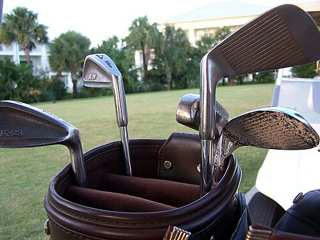
Photo: golf clubs, by post406, Creative Commons Attribution license. File: Wikimedia Commons.
After the clubs are yours
Clean the faces. Look at the grips. Keep the shopping note with the bag. If a club’s job is still unclear after you have played, that club is the one to ask about, not the whole set. Do not replace the set because one club feels odd. Write the odd club on a new row and take that row back.
If a friend tells you to change shafts because their set ‘goes farther,’ that is their experience. It is not a spec. Your note is the page you copied and the jobs you wrote. Choosing golf clubs for beginners ends when every club you paid for has a job you can say in one sentence, and when the blanks you could not fill are still blank rather than guessed.
Check the bag the night before you play. Count the clubs against the list. A club left in the car is not in the bag. A club a friend handed you at the range might push you over the count in Rule 4 if you do not notice it. The list is the check.
If the shop offered a trade-in, write what you gave them and what you kept. A trade-in is not a review of the old brand. It is a line on the note so you remember which clubs left the house.
Stand the clubs in the order you will pull them, not in the order the catalog prints them. The order is a memory aid. It is not a distance chart. If you cannot remember the job of a club from its place in the bag, the job was never written clearly enough. Rewrite that one sentence.
Concrete tip: before you pay, write one sentence for each club that names its job, and leave loft, shaft, and grip blank until you have copied them from the maker’s page or the tag.