
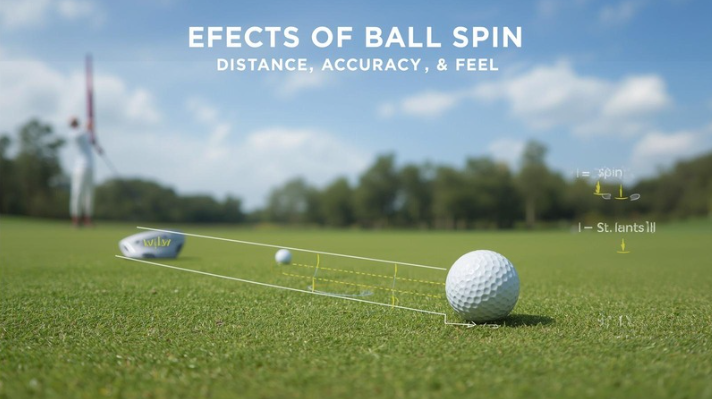
Ball spin in golf quietly controls almost everything you see in flight. While most players focus on swing speed or club selection, spin often decides whether a shot flies long and straight or short and sideways. Because of that, understanding spin becomes essential for consistent performance.
Every shot leaves the clubface with a certain rotation. That rotation influences lift, curvature, stopping power, and feedback at impact. When spin works in your favor, distance improves and accuracy tightens. However, when spin gets out of control, yardage suffers and dispersion widens.
If you’ve ever wondered why two similar swings produce different results, spin likely explains the difference. Let’s explore how ball spin shapes distance, direction, and feel from tee to green.
What Is Ball Spin in Golf and Why It Matters
Ball spin in golf refers to the rotational movement created at impact. The clubface contacts the ball, friction occurs, and rotation begins instantly. That rotation interacts with air resistance and gravity.
Backspin creates lift. Lift keeps the ball in the air longer. Side spin produces curvature. Curvature shapes draws and fades. Too much side rotation leads to slices and hooks.
Additionally, spin influences how the ball reacts on landing. High backspin allows shots to stop quickly. Lower spin promotes roll.
Because spin affects flight and rollout, it directly shapes scoring opportunities. Controlled spin produces predictable results. Uncontrolled spin creates inconsistency.
Understanding these principles helps you make smarter decisions with equipment and swing adjustments.
How Ball Spin in Golf Affects Distance
Distance depends on efficient launch conditions. Those conditions include ball speed, launch angle, and spin rate.
Too much backspin can reduce distance. Although the ball may climb high, excessive rotation causes drag. Drag slows forward momentum. As a result, shots fall short.
On the other hand, insufficient spin produces a flat trajectory. Flat shots drop quickly because they lack lift. Without adequate backspin, carry distance decreases.
Optimal ball spin in golf balances lift and forward momentum. Launch monitors often show ideal spin ranges based on club type. Drivers typically perform best with lower spin rates. Irons require more spin for controlled carry.
When spin aligns with swing speed and loft, distance increases naturally.
The Role of Spin Loft in Distance Control
Spin loft describes the difference between dynamic loft and angle of attack at impact. This number strongly influences ball spin in golf.
A larger spin loft creates more backspin. A smaller spin loft reduces rotation.
For example, a downward strike with an iron increases spin. That’s why irons stop faster on greens. Conversely, drivers benefit from upward attack angles that lower spin for maximum carry.
Managing spin loft helps players control distance gaps. Subtle adjustments in shaft lean or ball position influence dynamic loft. Those small changes alter spin and trajectory.
Therefore, understanding spin loft adds another layer of precision to your game.
Ball Spin in Golf and Shot Accuracy
Accuracy depends on predictable curvature.
Side spin tilts the spin axis. That tilt produces draws or fades. A slight tilt creates controlled shape. Excessive tilt results in wild misses.
When the clubface angle differs significantly from the swing path, side spin increases dramatically. Consequently, shots curve sharply offline.
Managing face angle at impact reduces unwanted rotation. A square face with a neutral path produces minimal side movement.
Ball spin in golf acts like steering. Controlled spin keeps the ball on target. Uncontrolled rotation pulls it away.
Reducing excessive spin stabilizes dispersion patterns.
Backspin and Stopping Power on Approach Shots
Approach shots demand precise spin control.
High backspin helps the ball stop quickly on firm greens. Without adequate spin, approach shots bounce and roll past targets.
However, too much spin can cause ballooning flight. Ballooning reduces carry distance and consistency.
Premium golf balls often generate higher spin with wedges. Meanwhile, lower compression balls may reduce spin slightly.
Choosing the right ball influences spin rates significantly. Additionally, clean grooves improve friction at impact. Dirty grooves reduce spin and control.
Because short game precision depends on stopping power, ball spin becomes a scoring tool rather than just a flight factor.
How Ball Spin Influences Feel at Impact
Feel connects closely to spin characteristics.
Higher spinning shots often feel softer at contact. Lower spin shots may feel firmer or quicker off the face.
Compression rating also affects feel perception. Softer balls compress more easily, producing smoother feedback.
However, spin generation also contributes to sensory feedback. When friction occurs between clubface and ball, vibration patterns change. Those patterns travel up the shaft into your hands.
Many golfers describe well-struck, properly spinning shots as “pure.” That sensation builds confidence.
Therefore, spin influences both performance metrics and emotional response.
Equipment Factors That Shape Ball Spin in Golf
Equipment selection significantly affects spin rates.
Loft remains the primary factor. More loft produces more spin. Less loft reduces rotation.
Shaft flex influences dynamic loft and timing. Softer shafts may increase launch and spin slightly. Stiffer shafts often reduce spin for faster players.
Clubhead design also plays a role. Drivers with forward center of gravity positions lower spin. Irons with specific groove designs enhance spin control.
Golf ball construction impacts spin as well. Multi-layer urethane balls generate more spin on short shots. Surlyn-covered balls typically spin less.
Matching equipment to swing characteristics ensures optimized ball spin in golf.
Environmental Conditions and Spin Performance
Weather conditions affect spin behavior.
Cold air increases density. Dense air creates additional drag. Drag exaggerates the impact of excessive spin.
Wind amplifies side spin effects. Crosswinds push curving shots further offline. Into-the-wind shots with high spin balloon quickly.
Dry conditions often reduce greenside spin because moisture levels decrease friction. Conversely, wet conditions reduce spin dramatically due to reduced groove interaction.
Understanding environmental variables helps you adjust expectations.
Spin behaves differently under varying circumstances.
Common Spin Problems and How to Fix Them
Excessive driver spin often results from high dynamic loft. To reduce it, tee the ball slightly higher and strike upward.
Low iron spin may stem from shallow attack angles. Improve ball-first contact to increase spin loft.
Severe slices occur when face angle remains open relative to path. Work on squaring the clubface through impact.
Hooks develop when the face closes excessively. Neutral grip pressure may help stabilize rotation.
Small adjustments produce noticeable spin changes.
Because spin responds quickly to technique changes, practice with intention.
Using Launch Monitors to Understand Ball Spin in Golf
Technology provides valuable insights.
Launch monitors measure spin rate, spin axis, and carry distance. Data reveals patterns invisible to the naked eye.
For instance, if your driver spin averages 3,500 rpm, distance may suffer. Reducing spin closer to optimal levels improves carry.
Iron spin rates also indicate whether shots will hold greens. Monitoring these numbers during fitting sessions refines equipment choices.
Because data clarifies cause and effect, you gain control over performance variables.
Knowledge transforms guesswork into precision.
Balancing Spin for Different Clubs
Each club demands specific spin characteristics.
Drivers benefit from lower spin to maximize distance. Fairway woods require moderate spin for balanced carry and rollout.
Mid-irons need consistent backspin for predictable landing angles. Wedges demand higher spin for stopping control.
Trying to create uniform spin across all clubs would reduce performance. Instead, balance spin according to purpose.
Understanding these distinctions helps refine strategy and club selection.
Practical Drills to Improve Spin Control
Improving spin control requires deliberate practice.
First, focus on centered contact. Strike location affects spin consistency.
Second, experiment with ball position. Slight adjustments influence dynamic loft.
Third, practice half-wedge shots to learn trajectory control. Vary swing length while maintaining tempo.
Additionally, maintain clean grooves. Clean grooves preserve friction.
Consistent routines improve both spin rate and feel awareness.
Practice builds understanding.
Conclusion: Master Ball Spin for Total Control
Ball spin in golf shapes distance, accuracy, and feel more than most players realize. Backspin controls lift and stopping power, while side spin determines curvature. When spin aligns with swing speed, loft, and equipment, shots become predictable and powerful.
Instead of chasing distance through force, refine your spin control. Adjust technique thoughtfully. Choose equipment wisely. Monitor data carefully. Because spin influences every phase of ball flight, mastering it unlocks true performance consistency.
When you understand spin, you understand control. And control lowers scores.
FAQ
- What is the ideal spin rate for a driver?
Most golfers perform best with driver spin between 2,000 and 3,000 rpm depending on swing speed. - Does higher spin always mean shorter distance?
Not always. Proper spin creates lift, but excessive spin increases drag and reduces carry. - How can I increase wedge spin?
Use clean grooves, premium balls, and focus on ball-first contact. - Can golf balls change spin rates significantly?
Yes. Urethane-covered balls typically produce higher spin on short shots than surlyn models. - Why does my ball curve too much?
Excessive side spin caused by face-to-path mismatch creates dramatic curvature.