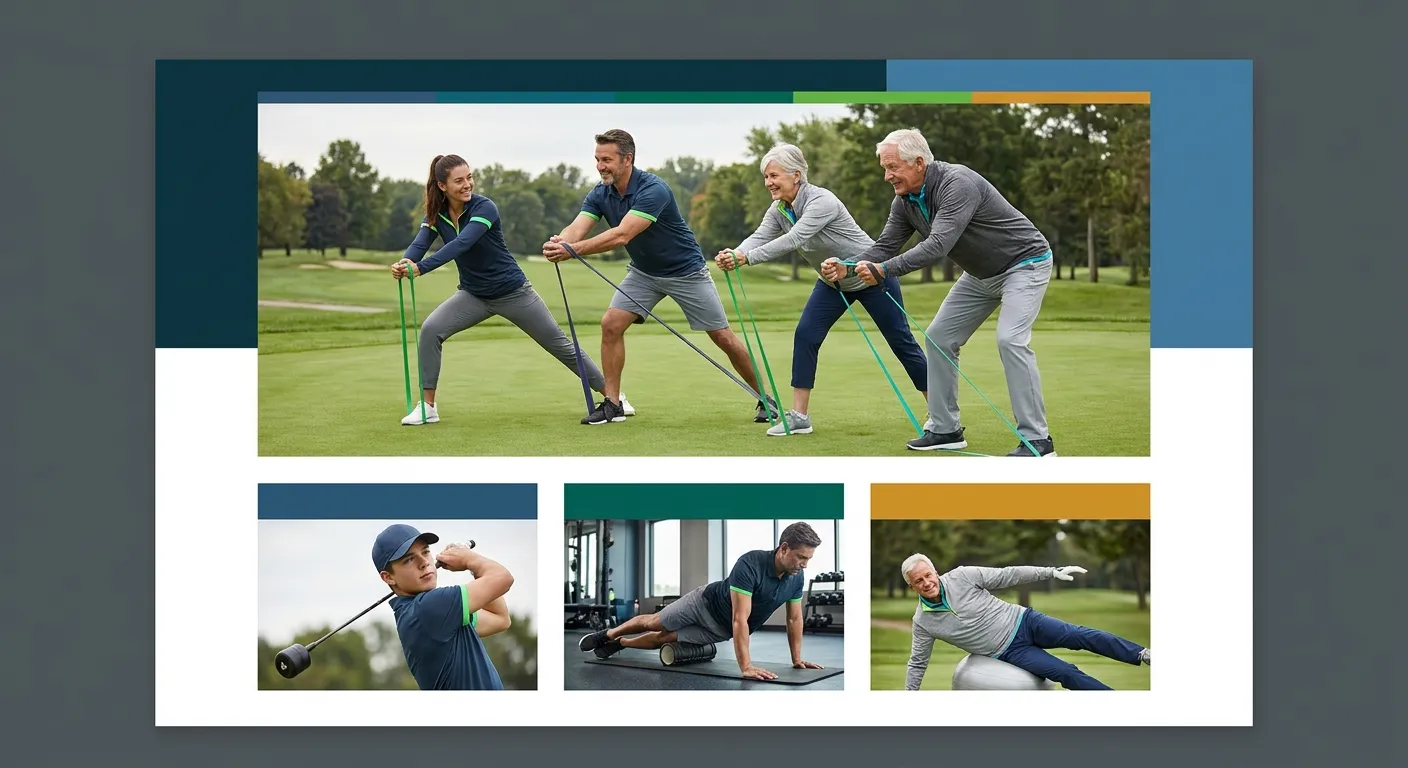
Golf fitness for all ages begins with matching activity to the person, rather than assigning every golfer the same workout. Age, current activity, health, ability and the way you play all matter. A practical plan considers general physical activity alongside the particular demands of practice and a round.
This is general educational health information, not medical advice, diagnosis or an individual exercise prescription. It uses current CDC guidance and Mayo Clinic golf resources rather than personal fitness testing. Consult an appropriately qualified clinician about a health concern or exercise restrictions, and use suitable professional guidance for a new training program. No routine guarantees injury prevention, distance gains or lower scores.
Start with your actual golf activity
Describe what a typical session involves: walking or riding, terrain, length of play, time on the range and how you handle equipment. Two golfers of the same age may have very different starting points. A date of birth alone is not enough to choose a program.
Identify the task you want to prepare for without diagnosing a weakness yourself. For example, the question may concern returning to regular play after a break or fitting practice into an active week. A clear description helps a professional understand the context before suggesting an appropriate approach.
Keep health and performance goals separate
General physical activity guidance concerns health; a golf coach may address technique and practice; a clinician can assess a health concern. These roles can complement one another, but they should not be treated as interchangeable. A club fitting or swing app is not a medical assessment.
Likewise, a better score should not be used as the only measure of a health plan. The purpose and relevant measures depend on the individual program. Do not assume a session was ineffective merely because the next round’s score did not change.
Understand the adult activity framework
The CDC adult overview describes at least 150 minutes of moderate-intensity activity each week, or 75 minutes of vigorous activity or an equivalent combination, plus muscle-strengthening activity on at least two days. These are general public-health recommendations, not a golf-specific workout for every reader.
The guidance allows activity to be spread through the week and divided into smaller periods. Read the complete source and relevant guidance for your circumstances. Do not interpret a golf booking or a long time spent at the course as automatically establishing the intensity or amount of activity recommended.
Record activity accurately
Keep the type, duration and relevant effort information distinguishable. A round using a cart, a walk and a strength session are different entries. Recording the context is more useful than assigning every golf outing the same exercise value without evidence.
If you are unsure how an activity fits the general framework, use the official explanation or ask an appropriate professional. Do not replace that question with an unsupported claim that golf alone meets every physical-activity requirement.
Children and adolescents need an age-appropriate approach
The CDC child overview distinguishes preschool children from those aged six to seventeen. It describes activity throughout the day for ages three to five and at least sixty minutes of daily activity for the older group, with age-appropriate aerobic, muscle- and bone-strengthening components.
Those recommendations concern overall activity rather than prescribing sixty minutes of golf practice. A junior’s program should consider development, enjoyment, supervision and other activities. Do not simply scale down an adult resistance workout or copy an elite player’s training routine.
Connect the adults supporting a junior
A caregiver and qualified junior coach can discuss what the child enjoys and how practice fits the week. A clinician can address health concerns. Keep those conversations distinct from claims that more intensive training is necessary for talent or future success.
Use suitable facilities and clear supervision for equipment and practice tasks. A structured golf session is only one possible part of a child’s activity. Do not present early specialisation or a particular volume as a universal path to better performance.
Older adults should consider ability and conditions
The CDC older-adult overview covers people aged sixty-five and older and includes aerobic, muscle-strengthening and balance activities. It also says to be as physically active as abilities and conditions allow when the general recommendations are difficult to meet.
That is different from declaring everyone over fifty-five a senior golfer with the same limitations. Avoid arbitrary age bands or assumptions about strength and mobility. Discuss the person’s current ability, preferences and relevant health circumstances rather than age alone.
Plan the round as well as the workout
Consider course access, terrain, transport and the length of the session when arranging play. Identify options available at the facility rather than assuming every golfer must walk a full round or carry a bag to participate properly.
Those planning choices should match individual needs and relevant professional advice. They are not evidence that one type of equipment or a particular playing format prevents falls or joint problems. Leave health questions to appropriate assessment.
Prepare for practice and play
Mayo Clinic’s golf warmup resource demonstrates a dynamic preparation approach for the rotational demands of the swing. Use the source to understand its context and seek individual guidance when necessary. Do not turn a short demonstration into a promise that every golfer can perform every movement safely.
Allow preparation time in your session rather than treating the first full swing as the warmup. Follow a suitable plan you understand and avoid copying unfamiliar movements simply because they appear in an online video. A golf-specific resource supports preparation; it does not replace personal assessment.
Review strength, mobility and balance questions
Mayo Clinic’s golf-injury discussion addresses warmup, strength and mechanics and cautions about returning to play with too much activity too soon. Read the whole context rather than borrowing a headline as a guarantee that injuries are preventable in every case.
If your plan includes resistance or mobility work, ask the qualified professional to explain the purpose, suitable technique and progression. This article does not prescribe loads, repetitions or a movement for treating back pain. A generic exercise name is not enough to establish appropriateness.
Keep progression individual
Record the current program and any changes so the person guiding it can understand what you are doing. Do not increase duration, resistance and golf practice together merely because one session felt manageable. Use the progression appropriate to the actual plan and circumstances.
Returning after a break also deserves context. A former training level is not automatically the current starting point. Discuss relevant symptoms, restrictions or uncertainties with the appropriate professional instead of using a golf article to self-diagnose readiness.
Fit activity into the week
List the golf sessions and other planned activities before adding a new program. Identify available time, facilities and professional support. A realistic schedule is easier to discuss than an ambitious routine copied without regard to daily responsibilities.
Keep changes manageable and consistent with applicable guidance. The aim is an appropriate activity plan, not a universal off-season formula or a guarantee of playing longer. Different people may need different arrangements even when they share a similar golf goal.
Evaluate fitness products without medical promises
Ask what a device or training aid actually measures, what its provider documents and which task it supports. A readiness score or movement graphic should not be treated as a diagnosis or clearance to exercise. Check relevant professional guidance before relying on a health interpretation.
Do not assume a premium program, app or piece of equipment is necessary for every golfer. Identify the need first and compare documented requirements. Marketing promises of fewer injuries or greater distance need evidence that matches the actual claim and its limits.
FAQ
Is there one golf workout for every age?
No. General activity guidance and individual ability, health and goals need separate consideration.
Does playing golf meet all activity recommendations?
Do not assume that. Record the type and effort of activity and consult the relevant official guidance.
Can fitness guarantee lower scores?
No guarantee is established here. Health activity and golf performance are related questions with different individual factors.
Which exercise should I use for back pain?
This guide does not prescribe treatment. Seek appropriately qualified clinical assessment and advice for that health concern.