
AI powered golf training on this page is a log. It is not a review of a product, and it is not a claim that a sensor coaches you. An earlier draft named devices, a trade show, and market figures. Those lines are gone. If a product makes a promise, the promise lives on that product’s page. This article tells you how to write down what a training device said, next to what you saw, without turning either into a lesson this site did not give.
AI powered golf training is still a sheet of paper
Write the device name from the label. Write the date. Write the place: grass, mat, or a net. Write the club and the ball. Write the one question you are asking, such as whether the start direction matches the target you chose. One question is the session. A second question is a second sheet.
If the device prints a sentence of advice, copy the sentence exactly and mark it as the device’s words. Do not improve the sentence. Do not add a reason the device did not give. Advice you rewrote is no longer the device’s output, and it is not your sight either. It is a third thing, and it does not belong on the log.
Two columns that must not be merged
One column is the device. Numbers, words, and any label the screen gives, such as measured or modeled. Trackman explains modeled ball flight on its normalization page. That page is about Trackman’s feature. If your device is not Trackman, do not borrow the definition. Ask the manual what the field means, and write ‘manual’ or ‘not in the manual.’
The other column is your eyes. Where the ball started relative to a target you named. Whether you felt the club slip. Whether you stopped the session because the setup moved. Eyes and device stay apart. If you only keep the device column, you have a printout, not a training log.
A video, if the device records one, is a third column. Write whether you watched it. A file you did not watch is not feedback. It is storage. Note the file name so you can find it, and do not describe a swing you did not look at.
What the log is not allowed to say
It is not allowed to say the device fixed your swing. A later shot can differ for many reasons, including the ball, the lie, and the fact you were trying something else. It is not allowed to say a wrist angle or a grip pressure caused a miss unless a person qualified to say that told you, and you write their name. This page will not supply that cause.
It is not medical advice. A device that comments on your body is still a device. Pain, dizziness, or a joint that does not feel right is a reason to stop and ask a clinician. Do not use a training log as a clinic note.
It is not a conforming-equipment ruling. Practice devices and clubs you might use in a competition are different objects. Read the USGA equipment standards page before you assume a practice club is allowed in an event. This article will not make that call.
A human coach, if you have one
If you take the log to a teacher, hand them both columns. Ask them to mark what they will use and what they will ignore. Write their mark. A teacher who only wants the video should say so. A teacher who will not look at the device should say so. Either answer is usable. A silent shrug is not, and you should write ‘no answer’ rather than invent one.
Do not ask the teacher to promise a score. Ask what you will repeat next time, in one drill you can do without the device if the battery dies. The drill is theirs. The log just holds it. If you cannot do the drill without remembering a number, it is not yet a drill. Ask for a version you can repeat on a range with no screen.
You can read other notes on Golf Place. Use them for vocabulary. Use the device manual for definitions. Use a teacher’s words for a drill. Use the USGA page for equipment rules.
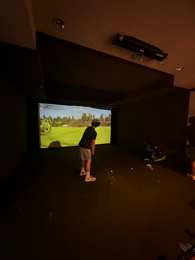
Photo: a golf simulator, by Kjaskren, public domain. File: Wikimedia Commons.
When the device and your eyes disagree
Write ‘disagree’ and stop adding swings to that block. Check the setup against the manual. Check that you are looking at the target you named, not at a different flag. If the setup was wrong, the block is void. Draw a line. Do not average the void block into the next one.
If the setup was right and they still disagree, the log has done its job. You now have a question for the manual or for a teacher. You do not have a permission to pick the column you like better. Picking the flattering column is how a log becomes advertising.
Battery, subscription, and indoor space are practical lines at the bottom of the sheet. If a session ended because the app locked, write that. A locked app is not a swing fault. It is a reason the sheet is short. Do not fill the missing swings from memory.
Keeping the log small enough to reread
One page, one question, one device. If you need a second device, it gets its own page, even on the same day. Stapling two printouts together without names is how the numbers get swapped. Write the device name at the top in letters large enough to see when the page is in the bag.
At the end of the week, you should be able to say the question you asked and whether you can repeat the setup. If you cannot, the week was a pile of screenshots. AI powered golf training, as this page uses the phrase, fails when the screenshot has no target, no ball, and no manual beside it.
Throw away nothing that has a date and a device name. A dull page is a record that you showed up and that the setup was ordinary. Ordinary is what makes a later strange page mean something. A folder of only the best screenshots is a highlight reel, and a highlight reel is not training.
If you stop using the device, write the date you stopped and the reason in plain words, such as ‘battery’ or ‘I did not read the numbers.’ That line keeps you from restarting with a story about how the device changed your swing. The pages either show a repeated question or they do not.
Concrete tip: copy the device’s sentence exactly, write the start direction you saw beside it, and stop the block if you cannot name the target you were using.
Sharing the log without turning it into a claim
If you show the page to a friend, show the question and the two columns, and say that the advice sentence belongs to the device. Do not introduce it as what you ‘learned’ unless you can point to the drill a person gave you. A forwarded screenshot with the question cropped off is not the log. It is the flattering half. Send the whole page or do not send it.
If the device asks you to create an account, write whether you did. A session that lives only in an account you cannot open later is a session you do not have. Export or copy the lines before you rely on the login. AI powered golf training that you cannot reread is a notification, not a record.
End the page with the next action in one line: repeat the same question, ask a teacher, or stop until the manual is open. A page with no next action invites you to buy another device. The next action should be possible on the range you already use.