
Many golfers spend years trying to fix their swing without realizing the real problem might be their equipment. When golf clubs don’t fit your body or swing, even solid technique can produce inconsistent results. Because of this, players often develop bad habits while trying to compensate for issues caused by poor club fit.
At first, the signs can be subtle. You may notice small inconsistencies or slight discomfort during your swing. However, over time, these issues become more noticeable and start affecting your overall performance. Therefore, recognizing when golf clubs don’t fit is one of the most important steps toward improving your game.
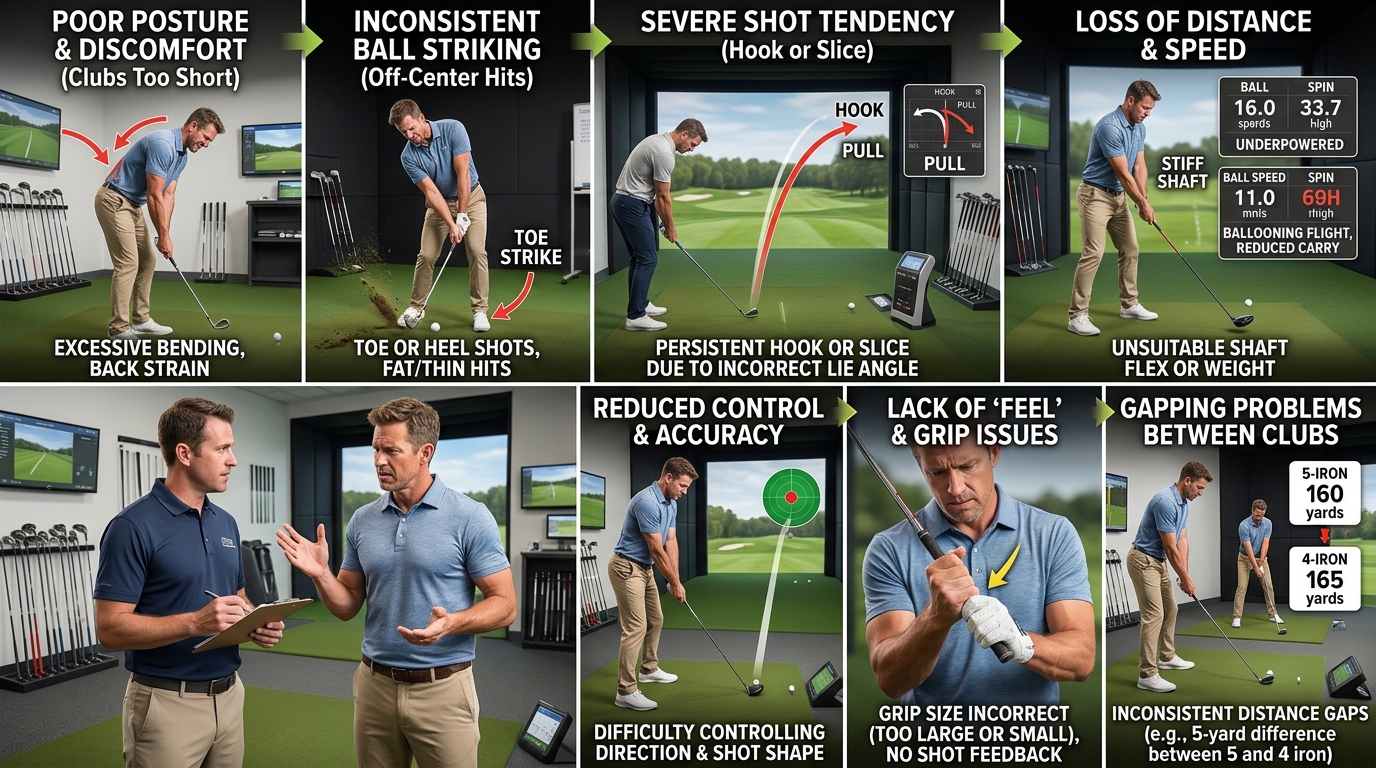
Inconsistent Ball Striking And Contact Issues
One of the most common signs that golf clubs don’t fit is inconsistent ball striking. You may hit one shot perfectly and the next one poorly, even though your swing feels the same. Because of this inconsistency, it becomes difficult to build confidence.
When club length or lie angle is incorrect, the clubface may not meet the ball squarely. As a result, you may hit thin, fat, or off-center shots more often. In addition, inconsistent contact can lead to unpredictable distances.
Even with good fundamentals, poor fit can make consistency nearly impossible. Therefore, if you struggle with repeated mishits, it may be a sign that your golf clubs don’t fit your swing properly.
Uncomfortable Setup And Poor Posture
Another clear indication that golf clubs don’t fit is discomfort during setup. Your posture should feel natural and balanced. However, if you feel forced into an awkward position, your clubs may not match your body.
For example, clubs that are too long may cause you to stand too upright. On the other hand, clubs that are too short may force you to bend excessively. As a result, your swing becomes restricted and less efficient.
In addition, poor posture can lead to tension. This tension affects your ability to swing freely. Therefore, if your setup feels uncomfortable, it is likely that your golf clubs don’t fit your physical build.
Ball Flight That Feels Unpredictable
Ball flight provides valuable feedback about your equipment. When golf clubs don’t fit, your shots may not behave as expected. Because of this, you may struggle to control direction and trajectory.
For instance, incorrect lie angles can cause the ball to consistently go left or right. Similarly, mismatched shafts can affect launch and spin. As a result, your ball flight becomes inconsistent.
Even if your swing path is correct, poor club fit can distort your results. Therefore, unpredictable ball flight is a strong sign that your golf clubs don’t fit your game.
Difficulty Controlling Distance
Distance control is essential for scoring well. However, when golf clubs don’t fit, achieving consistent distances becomes difficult. You may notice that similar swings produce different results.
Incorrect shaft flex is often a factor. If the shaft is too stiff, you may struggle to generate power. Conversely, a shaft that is too flexible can create timing issues. As a result, your distances vary unpredictably.
In addition, improper club length can affect your swing arc. This further impacts distance consistency. Therefore, if you cannot rely on your distances, your golf clubs don’t fit your swing.
Frequent Misses In The Same Direction
Patterns in your misses can reveal a lot about your equipment. If you consistently miss in the same direction, it may indicate that your golf clubs don’t fit your swing.
For example, shots that repeatedly go left could be caused by a lie angle that is too upright. On the other hand, shots that leak right may result from a lie angle that is too flat. Because of this, directional misses often point to fitting issues.
While swing flaws can also cause these patterns, consistent directional errors are often linked to equipment. Therefore, recognizing these trends can help you identify when your golf clubs don’t fit.
Lack Of Comfort And Increased Fatigue
Comfort plays a major role in performance. When golf clubs don’t fit, you may feel discomfort during your round. This discomfort can lead to fatigue, especially over 18 holes.
For example, grips that are too small or too large can strain your hands. In addition, improper shaft weight can make the club feel difficult to control. As a result, your energy levels drop more quickly.
Over time, this fatigue affects your swing consistency. Therefore, if you feel unusually tired or uncomfortable, it may be because your golf clubs don’t fit your needs.
Struggling To Improve Despite Practice
Many golfers practice regularly but see little improvement. When golf clubs don’t fit, progress becomes harder to achieve. Because of this, you may feel stuck despite your efforts.
Poorly fitted clubs can mask improvements in your swing. Even if your technique gets better, the results may not reflect it. As a result, you may become frustrated and lose confidence.
In addition, compensating for equipment issues can create bad habits. These habits are difficult to break. Therefore, if you are not improving despite practice, your golf clubs don’t fit your game.
How Proper Fitting Solves These Problems
The good news is that these issues can be corrected. Professional fitting helps ensure that your clubs match your body and swing. Because of this, it eliminates many of the problems caused when golf clubs don’t fit.
During a fitting session, experts analyze your swing, posture, and ball flight. They adjust factors such as length, lie angle, and shaft type. As a result, your clubs become better suited to your game.
Proper fitting improves consistency, comfort, and confidence. Instead of compensating, you can focus on your technique. Therefore, addressing the issue of golf clubs don’t fit can lead to immediate improvements.
Why Small Adjustments Make A Big Difference
Even minor changes in club specifications can have a significant impact. When golf clubs don’t fit, small mismatches can create noticeable issues. However, correcting these details can transform your performance.
For example, adjusting lie angle by just a few degrees can improve accuracy. Similarly, selecting the right shaft flex can enhance distance and control. Because of this, attention to detail is essential.
Over time, these improvements build confidence. You begin to trust your equipment and your swing. Therefore, fixing the problem of golf clubs don’t fit leads to long-term benefits.
Conclusion
Golf is a game of precision, and every detail matters. When golf clubs don’t fit, they can quietly undermine your performance and make improvement more difficult. From inconsistent ball striking to discomfort and fatigue, the signs are often clear once you know what to look for.
By recognizing these warning signs, you can take the first step toward better performance. Proper club fitting aligns your equipment with your swing, allowing you to play with greater consistency and confidence.
Ultimately, addressing the issue of golf clubs don’t fit is not just about equipment. It is about unlocking your full potential and enjoying the game at a higher level. With the right fit, every shot becomes more predictable, and every round becomes more rewarding.
FAQ
1. How do I know if my clubs are the wrong size?
If your posture feels uncomfortable or your contact is inconsistent, your clubs may not match your body.
2. Can poor club fit affect accuracy?
Yes, incorrect lie angle and shaft type can cause directional errors and inconsistent shots.
3. Should beginners get fitted for clubs?
Yes, proper fit helps beginners develop good habits and avoid compensations.
4. How often should I check my club fit?
You should review your setup every few years or after significant swing changes.
5. Does shaft flex really matter?
Yes, the right shaft flex improves timing, distance, and overall control.